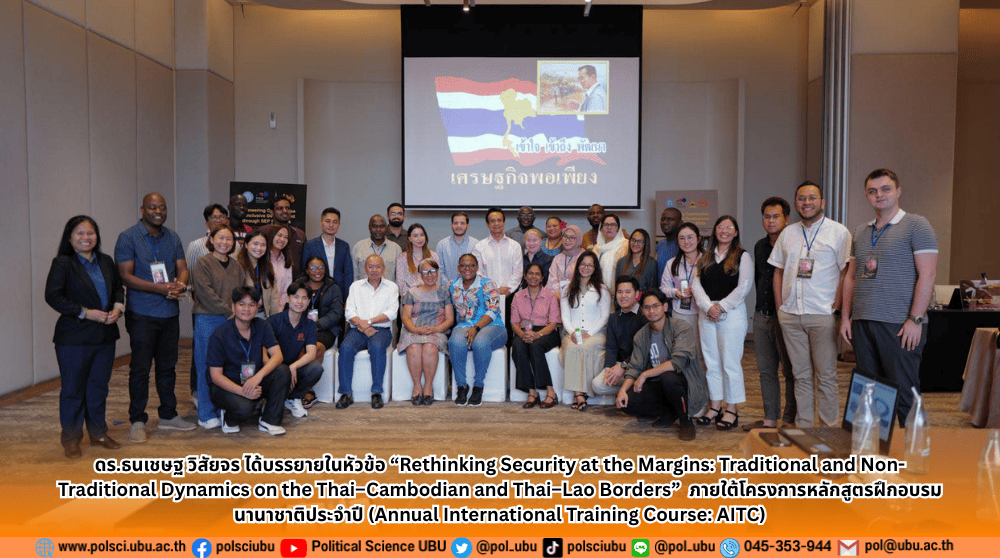
ดร.ธนเชษฐ วิสัยจร ได้บรรยายในหัวข้อ “Rethinking Security at the Margins: Traditional and Non-Traditional Dynamics on the Thai–Cambodian and Thai–Lao Borders”
[English below]
ดร.ธนเชษฐ วิสัยจร ได้บรรยายในหัวข้อ “Rethinking Security at the Margins: Traditional and Non-Traditional Dynamics on the Thai–Cambodian and Thai–Lao Borders” ร่วมกับการบรรยายของ พลเอก พิเชษฐ์ วิสัยจร ในหัวข้อ “Implementing Sufficiency Economy to Overcome Poverty and Hardship: The Cases of Timor-Leste and Thailand” โดยการบรรยายทั้งสองหัวข้อนี้ได้สะท้อนให้เห็นถึงบทบาทของประเทศไทยในการมีส่วนร่วมต่อการพัฒนาที่ยั่งยืนในต่างประเทศ
การบรรยายดังกล่าวจัดขึ้นภายใต้โครงการหลักสูตรฝึกอบรมนานาชาติประจำปี (Annual International Training Course: AITC) เรื่อง “Empowering Communities for Inclusive Development through SEP for SDGs: Lessons from Community-Based Participatory Research and Community-Driven Development in Thai Isan Villages” โดยมี ดร.ฐิติพล ภักดีวานิช เป็นผู้อำนวยการโครงการ และได้รับการสนับสนุนงบประมาณจากกรมความร่วมมือระหว่างประเทศ (Thailand International Cooperation Agency: TICA) กระทรวงการต่างประเทศ ระหว่างวันที่ 1–15 พฤษภาคม 2569
โครงการมีผู้เข้าร่วมจำนวน 28 คน จาก 17 ประเทศ เพื่อศึกษาการเสริมสร้างความเข้มแข็งของชุมชนในพื้นที่ภาคอีสาน ได้แก่ จังหวัดอุบลราชธานี สกลนคร และนครพนม โดยมีวัตถุประสงค์เพื่อส่งเสริมความร่วมมือระหว่างประเทศในกลุ่มโลกใต้ (Global South) ผู้เข้าร่วมมาจากหลากหลายภูมิภาค ได้แก่ แอฟริกา เอเชียและแปซิฟิก และลาตินอเมริกาและแคริบเบียน สะท้อนถึงความหลากหลายของมุมมองและประสบการณ์ โดยประกอบด้วยประเทศ อาร์เมเนีย อาเซอร์ไบจาน อินโดนีเซีย สปป.ลาว มาเลเซีย เมียนมา ปากีสถาน ศรีลังกา อุซเบกิสถาน ซามัว มาดากัสการ์ โมซัมบิก ไนจีเรีย ยูกันดา เอลซัลวาดอร์ และสาธารณรัฐโดมินิกัน
Dr Thanachate Wisaijorn delivered a lecture entitled “Rethinking Security at the Margins: Traditional and Non-Traditional Dynamics on the Thai–Cambodian and Thai–Lao Borders”, alongside General Pichate Wisaijorn’s lecture entitled “Implementing Sufficiency Economy to Overcome Poverty and Hardship: The Cases of Timor-Leste and Thailand”. Together, these lectures reflected on how Thailand can contribute to sustainable development beyond its borders.
The lectures were delivered as part of the Annual International Training Course (AITC) entitled “Empowering Communities for Inclusive Development through SEP for SDGs: Lessons from Community-Based Participatory Research and Community-Driven Development in Thai Isan Villages”. The programme is led by Dr Titipol Phakdeewanich as Project Director, with the generous support of the Thailand International Cooperation Agency (TICA), Ministry of Foreign Affairs, and is being held from 1–15 May 2026.
The programme brings together 28 participants from 17 countries to explore community empowerment in the Isan provinces of Ubon Ratchathani, Sakon Nakhon, and Nakhon Phanom, with the aim of promoting international cooperation among countries of the Global South. Participants represent a wide range of regions, including Africa, Asia and the Pacific, and Latin America and the Caribbean, reflecting a diversity of perspectives and experiences. The participating countries include Armenia, Azerbaijan, Indonesia, Lao PDR, Malaysia, Myanmar, Pakistan, Sri Lanka, Uzbekistan, Samoa, Madagascar, Mozambique, Nigeria, Uganda, El Salvador, and the Dominican Republic.
#ความมั่นคงชายแดน
#การพัฒนาที่ยั่งยืน
#เศรษฐกิจพอเพียงสู่สากล
#ความร่วมมือระหว่างประเทศ
#เสริมพลังชุมชนอีสาน
#รัฐศาสตร์มออุบล
#การเมืองและความสัมพันธ์ระหว่างประเทศ